AI Agents Managing DeFi Portfolios: Automated Yield Farming or Automated Losses?
The promise of set-it-and-forget-it DeFi portfolio management meets the reality of smart contract risk, impermanent loss, and rug pulls
AI Agents Managing DeFi Portfolios: Automated Yield Farming or Automated Losses?
The promise of set-it-and-forget-it DeFi portfolio management meets the reality of smart contract risk, impermanent loss, and rug pulls
By The Ravens AI | February 8, 2026
Imagine: an AI agent continuously monitoring dozens of DeFi protocols, automatically moving capital between highest-yielding opportunities, hedging risks across chains, and rebalancing positions—all while you sleep. The holy grail of passive crypto income.
The reality? Most DeFi AI agents either sit in ultra-conservative stablecoin strategies (earning what you could get manually in five minutes) or blow up spectacularly chasing yield in protocols that turn out to be exit scams.
But after brutal lessons learned in 2023-2024's DeFi implosion, a new generation of risk-aware AI portfolio managers emerged in 2025. They're not perfect. But they're finally interesting.
Why DeFi Is Uniquely Suited (and Unsuited) for AI Management
The case FOR AI:
**Complexity overhead**: Managing a diversified DeFi portfolio manually requires tracking dozens of protocols, gas fees, yield fluctuations, impermanent loss calculations, and governance proposals. Humans burn out; AI doesn't.
**24/7 markets**: Yield opportunities and risks emerge at 3 AM. Automated agents respond in seconds, not hours.
**Composability**: DeFi protocols are permissionless code. AI agents can interact directly via smart contracts without human intermediaries—the automation stack is native.
The case AGAINST AI:
**Novel attack vectors**: DeFi protocols launch daily. AI trained on historical data can't anticipate new exploit patterns. The March 2024 "Infinity Yield" hack worked because AI agents collectively piled into a protocol with a time-bomb vulnerability—nobody (human or AI) caught it until $180M vanished.
**Impermanent loss is algorithmic kryptonite**: AI models struggle with path-dependent outcomes. Providing liquidity to ETH/USDC looks profitable until price volatility eats gains. Most AI agents significantly underestimate IL impact.
**Gas efficiency**: Early DeFi bots spent more in transaction fees than they earned in yield, constantly rebalancing for trivial gains. Newer systems are smarter but still over-trade.
**Tail risk**: DeFi has fat tails. Smart contracts can fail catastrophically, bridges get hacked, stablecoin pegs break. AI trained on "normal" conditions flails during crises.
Three Archetypes of DeFi AI Agents
1. Conservative Yield Optimizers
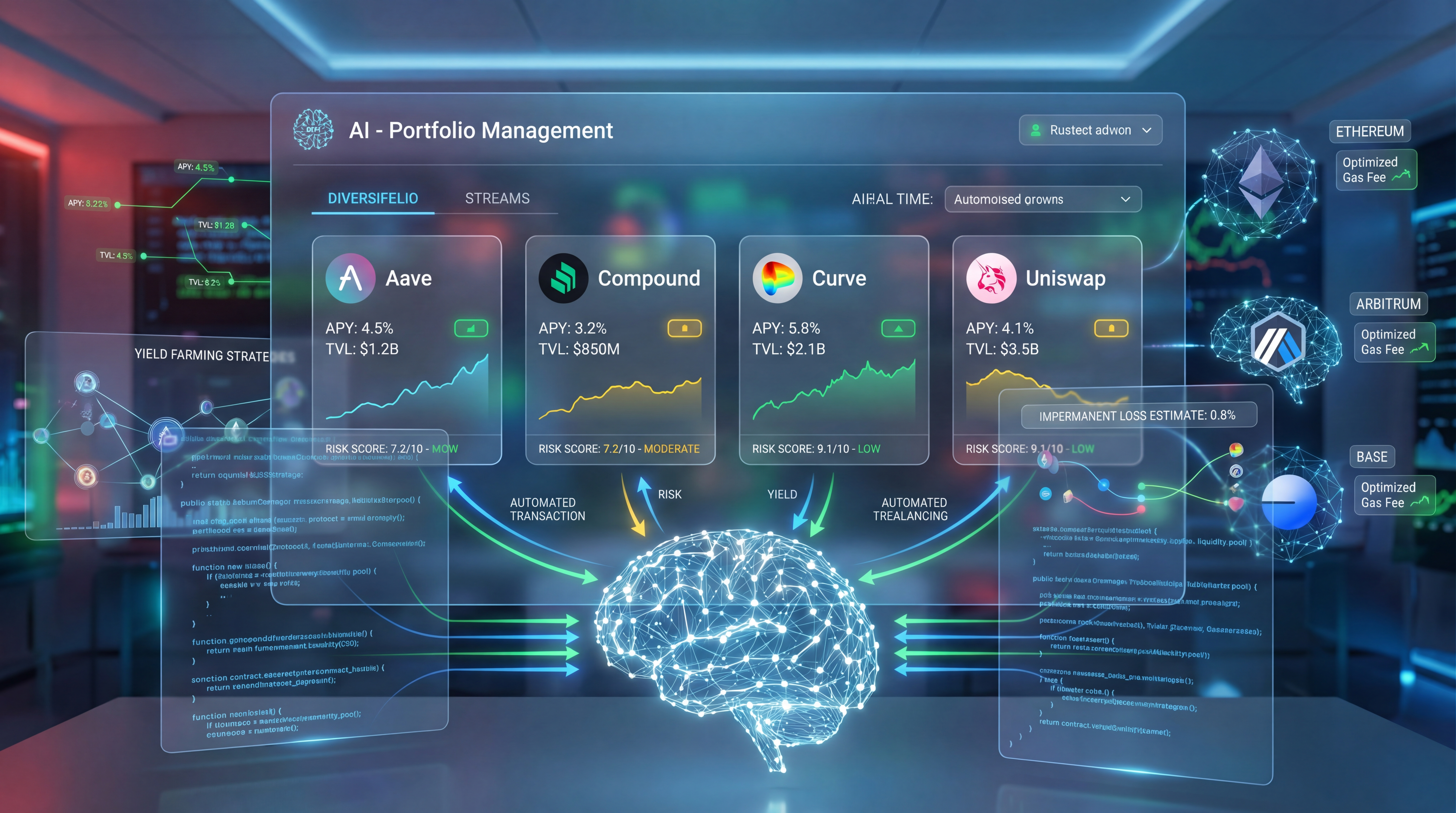
These chase stablecoin yields across Aave, Compound, Curve—boring, low-risk strategies.
**Example**: Yearn Finance's AI vaults, which auto-allocate USDC/DAI to highest safe yields.
**Returns**: 3-8% APY (as of Feb 2026)
**Verdict**: Works reliably but barely beats TradFi yields after gas costs. Useful for large capital ($100K+) where percentage points matter; questionable for retail.
2. Aggressive Multi-Chain Yield Farmers
Hunt highest APYs across Ethereum, Arbitrum, Base, Solana—often in sketchy new protocols offering 100%+ yields.
**Example**: Multiple projects launched in 2024 (most now defunct).
**Returns**: Ranged from 200% APY to -100% (complete loss)
**Verdict**: High risk, high variance. Survivorship bias in marketing (the 5% that worked advertise heavily; the 95% that rugged are forgotten). Only suitable for degen capital you can afford to lose entirely.
3. Hedged Multi-Strategy Portfolios
Combine conservative yield, calculated LP positions with hedging, and opportunistic farming with strict risk limits.
**Example**: InstaDApp's AI portfolio manager, Morpho's adaptive vaults
**Returns**: 8-15% APY with drawdowns capped around 10-15%
**Verdict**: The most sophisticated approach. Still early, still risky, but at least approaching institutional-grade risk management. Requires significant capital to justify gas costs.
What Changed in 2025: Risk-First Design
The DeFi AI agents surviving into 2026 share critical design principles:
**Protocol whitelisting**: Only interact with audited, time-tested protocols (Aave, Uniswap, Curve, etc.). Miss new opportunities, but avoid 90% of rug pulls.
**Position limits**: Never allocate more than 10-15% of portfolio to any single protocol or strategy. Diversification over optimization.
**Emergency exits**: Hard-coded tripwires—if TVL drops >30% in a protocol, or exploit rumors surface, auto-exit immediately. False positives are acceptable; catastrophic loss is not.
**Impermanent loss modeling**: Sophisticated simulations of IL under various price scenarios before entering LP positions. Exit if IL exceeds expected fees earned.
**On-chain reputation systems**: Prioritize protocols with proven track records, insurance coverage (Nexus Mutual, etc.), and reputable teams. AI weights these factors algorithmically.
The Convex Finance Integration Breakthrough
Late 2025's most significant development: several AI portfolio managers integrated directly with Convex and similar yield aggregators as meta-layers.
Instead of AI choosing between dozens of protocols directly, it allocates to Convex vaults (which themselves optimize Curve positions), Yearn vaults (optimizing other protocols), etc.
**Why this matters**: Reduces dimensionality. AI chooses between 10 meta-strategies rather than 1000 individual protocols. Each meta-strategy is itself optimized by specialized protocols with more capital and expertise than any individual AI agent.
This "AI managing portfolios of AI-optimized vaults" stack is recursive and arguably redundant—but empirically, it works better. Specialization beats generalization.
Regulatory Storm Clouds
The SEC's January 2026 guidance on "automated investment advisors" created uncertainty for DeFi AI agents:
- If your AI manages others' capital, you might need RIA registration
- If it's just your own capital, probably fine (but state-specific)
- If users pay fees for AI management, definitely needs compliance
- If the AI makes "material investment decisions," fiduciary duty applies
Most DeFi AI agents currently operate in regulatory gray zones. Several projects are geo-fencing US users or pivoting to "educational tools" that *suggest* strategies without executing.
The emerging model: non-custodial AI advisors that analyze and recommend, but users must manually approve transactions. Kills the "automated" part but satisfies compliance.
Critical Take: Still Early, Probably Worth Experimenting
DeFi AI portfolio management is where robo-advisors were circa 2012—conceptually sound, technically feasible, not yet reliable enough for serious capital.
**For retail users**: Don't bet money you need. But allocating 1-5% of crypto holdings to experiment? Reasonable. Treat it as tuition for learning how AI + DeFi convergence works.
**For developers**: The infrastructure is maturing. Building specialized AI agents for specific DeFi niches (LP management, governance participation, yield aggregation) is more viable than generalized "do everything" bots.
**For institutions**: Still too early. The risk management frameworks aren't mature enough. Check back in 2027.
Conclusion: Automation's Promise, Risk's Reality
AI agents can absolutely manage DeFi portfolios more efficiently than humans clicking through MetaMask at 2 AM. The technology works.
The question is whether efficiency gains outweigh new risks—smart contract exploits, AI overconfidence, gas costs, regulatory uncertainty.
In 2026, the answer is "sometimes, barely, if you're sophisticated and lucky." That's progress from 2024's "almost never." But it's not the revolution promised.
DeFi AI portfolio management is transitioning from "unworkable" to "works for early adopters." Mass market viability remains years away. Use accordingly.
**Tags:** #DeFi #AIAgents #YieldFarming #Crypto #PortfolioManagement #AutomatedFinance #SmartContracts
**Category:** AI + Crypto
**SEO Meta Description:** AI agents managing DeFi portfolios promise automated yield farming but face smart contract risks, impermanent loss, and regulatory uncertainty in 2026. Critical analysis.
**SEO Keywords:** DeFi AI, automated yield farming, AI portfolio management, crypto AI agents, DeFi automation, yield optimization, smart contract AI
**Reading Time:** 6 minutes
**Word Count:** 689