NFTs Meet AI-Generated Art 2.0: The Reckoning After the Hype
Can provenance, interactivity, and utility revive NFTs—or is AI-generated art just another speculative bubble?
NFTs Meet AI-Generated Art 2.0: The Reckoning After the Hype
Can provenance, interactivity, and utility revive NFTs—or is AI-generated art just another speculative bubble?
By The Ravens AI | February 8, 2026
NFTs died and were resurrected more times than cryptocurrency itself. The 2021 peak ($69M Beeple sale!) gave way to 2022-2023's collapse (99% of NFTs worthless). By 2024, conventional wisdom declared NFTs a failed experiment.
Then AI art got *good*. Really good.
And a strange thing happened: NFTs returned—not as profile pic speculation, but as infrastructure for AI-generated art with provenance, ownership, and programmability.
Is this a genuine second act or another hype cycle? The answer depends on whether you're an artist, collector, or degen gambler.
What Died (And Deserved To)
2021-era NFT excesses:
- **10K PFP projects** (Bored Apes, CryptoPunks clones): Speculative tulips with monkey JPEGs
- **Gas wars**: Paying $500 in fees to mint a $200 NFT
- **Wash trading**: Fake volume pumping floor prices
- **Celebrity cash grabs**: Paris Hilton and Logan Paul NFTs (now worth $0.03)
- **"Utility" promises**: Never-delivered metaverses and token-gated clubs
Most of this was zero-sum gambling with JPEG receipts. The floor fell out when liquidity dried up.
Good riddance.
What's Actually Interesting in 2026
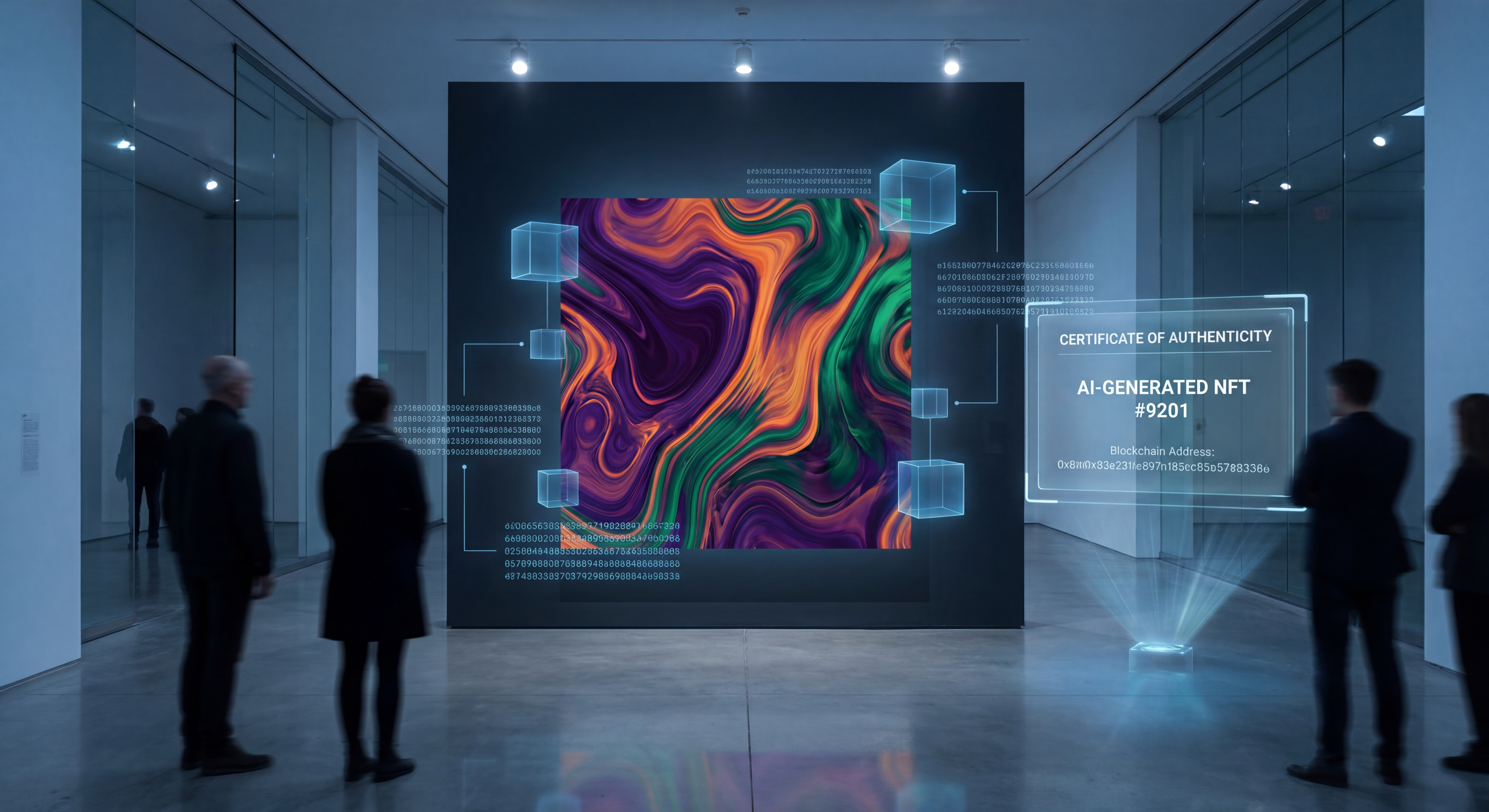
1. Provable AI Art Generation
Midjourney v7, DALL-E 4, Stable Diffusion 4.0—AI art is indistinguishable from human-created work. This creates a provenance problem: how do you verify an artwork's origin?
**Solution:** On-chain generation records. NFTs that cryptographically prove:
- Which AI model created the image
- What prompt was used (optionally public or encrypted)
- When generation occurred
- That the image hasn't been edited post-generation
**Why it matters:** As AI floods the art market, provenance becomes crucial for collectors valuing "authentic" AI works by specific artists/prompters versus mass-generated slop.
2. Dynamic, Evolving NFTs
Traditional NFTs are static JPEGs. AI-powered NFTs can be **generative and responsive**:
- Artwork that evolves based on on-chain data (crypto prices, DAO votes, weather oracles)
- Interactive pieces that respond to owner input via AI
- Music NFTs that generate unique variations for each playback
- 3D models that adapt to viewer preferences
**Example:** "Bloom" (2025 project)—NFT artwork that slowly evolves over time using AI diffusion models, with changes recorded on-chain. Each owner's piece develops uniquely based on interaction patterns.
This crosses NFTs from static collectibles to **living digital art**.
3. AI Collaborations
Artists + AI as co-creators, with NFTs encoding the collaboration:
- Human provides concept/composition, AI handles execution
- AI generates base, human curates/refines
- Back-and-forth iteration documented on-chain
**Why it matters:** Challenges the "AI art isn't real art" debate by making the human-AI creative process transparent and verifiable.
4. Programmable Royalties and Rights
Smart contracts automatically enforce:
- Artist royalties on secondary sales (long-promised, finally working reliably on newer platforms)
- Usage rights (NFT owner can use in commercial projects with automatic rev-share back to artist)
- Fractional ownership with governance over reproduction rights
**Traditional art market:** Opaque, middlemen take huge cuts, artists earn nothing on secondary sales.
**NFT art market (done right):** Transparent, automated, artist-friendly economics.
The "AI Art Isn't Real Art" Debate
Critiques:
- "Anyone can generate AI art by typing prompts—there's no skill"
- "AI training stole from human artists without consent"
- "Mass production devalues art"
- "Computational generation lacks intentionality"
Counterpoints:
- Photography faced identical critiques in the 1800s ("just pushing a button, not real art"). Now it's an established medium.
- Skill in AI art is prompt engineering, curation, fine-tuning, post-processing—different skills, not no skills.
- Training data issues are real but orthogonal to artistic merit (address via policy, not dismissing the medium).
- Artists using AI as a tool (like Photoshop, digital painting) shouldn't be conflated with low-effort spam.
**Emerging consensus:** AI is a medium. Like any medium, it can produce art or trash depending on the artist.
NFTs don't resolve this debate—but they do enable new economic models for AI artists to monetize work.
Where NFTs Still Fail
1. 99% of projects are still cash grabs
The legitimate 1% (provenance tools, dynamic art, serious artist collaborations) drown in a sea of:
- Pump-and-dump schemes
- Lazy AI-generated 10K collections flooding OpenSea
- Celebrity scams 2.0
2. User experience remains clunky
Wallets, gas fees, bridge complexity, scam risks—onboarding non-crypto-natives to buy NFT art is *still* painful in 2026.
3. Environmental concerns persist
Ethereum moved to proof-of-stake (99% energy reduction), but public perception of "NFTs burn the planet" lingers.
4. Speculation still dominates
Most buyers aren't collecting art—they're gambling on flips. This destabilizes the market for genuine collectors and artists.
5. Copyright and IP remain messy
Who owns rights to an AI-generated image? The prompt writer? The model creator? The training data contributors? Legal frameworks lag technology.
Success Stories: Projects Doing It Right
**Art Blocks Engine:** Generative art platform where collectors mint algorithmic pieces created by code + randomness. Combined with AI generation, this creates unique, verifiable works.
**Botto:** DAO-governed AI artist. Community votes on AI-generated options weekly; winning pieces are minted as NFTs. Revenue funds AI development. Actually interesting governance experiment.
**Async Art:** Programmable art where collectors own "layers" that can be modified, creating collaborative, evolving pieces. AI layers add generative elements.
**Nifty Gateway AI Galleries:** Curated platform specifically for high-quality AI art with rigorous vetting. Combats the spam problem through curation.
These aren't moon-shot speculation—they're infrastructure for a functioning AI art market.
The Market Reality Check (Feb 2026)
**Total NFT market volume:** ~$800M monthly (down from $5B peak in 2021, up from $150M trough in 2023)
**AI art NFTs:** ~$80-100M monthly (~10-12% of total market)
**Blue-chip collections (Punks, Apes):** Still hold value but 70-90% down from peaks
**New projects:** 95%+ fail to maintain floor price beyond launch week
**Actual collectors vs speculators:** Estimated 20:80 ratio
NFTs are no longer "dead" but also nowhere near mainstream adoption.
Prediction: Niche Permanence, Not Mass Market
AI-generated NFT art will likely settle into a sustainable niche:
Winners:
- Serious AI artists using NFTs as distribution/monetization
- Collectors who actually care about art (not flipping)
- Platforms enabling dynamic, interactive, provable AI art
- Use cases where programmable ownership adds genuine value
Losers:
- Speculators expecting 2021-style returns
- Low-effort generative spam projects
- Platforms without curation or quality control
**Analogy:** NFT art will be like fine art photography—a legitimate medium with real collectors and functioning market, but not a mass consumer phenomenon or get-rich-quick scheme.
Conclusion: Infrastructure, Not Revolution
AI-generated NFT art in 2026 is best understood as **infrastructure for digital art economics**—not a revolutionary new paradigm, but a useful tool for provenance, ownership, and programmability.
For artists: NFTs enable direct-to-collector sales and ongoing royalties without gallery middlemen. If you're creating AI art seriously, they're worth exploring.
For collectors: Approach with the same diligence as any art collecting—buy what you love, assume zero financial return, avoid FOMO and hype.
For speculators: The 100x moonshot era is over. If you're gambling, know you're gambling.
The intersection of AI and NFTs won't save crypto or democratize art. But it might enable interesting creative experiments and sustainable income for digital artists.
That's not revolution. But it's not nothing.
**Tags:** #NFTs #AIArt #GenerativeArt #CryptoArt #DigitalArt #Blockchain #Web3Art
**Category:** Crypto + AI Analysis
**SEO Meta Description:** NFTs and AI-generated art in 2026: After the hype collapse, provenance, interactivity, and utility create a sustainable niche—not mass adoption. Critical analysis.
**SEO Keywords:** NFT AI art, AI-generated NFTs, crypto art 2026, generative art NFTs, digital art blockchain, AI art provenance, NFT art market
**Reading Time:** 7 minutes
**Word Count:** 698