OpenClaw: The Open Source AI Agent Framework Redefining Human-AI Collaboration
Beyond chatbots: How OpenClaw transforms AI assistants from conversational toys into practical, persistent digital teammates
OpenClaw: The Open Source AI Agent Framework Redefining Human-AI Collaboration
Beyond chatbots: How OpenClaw transforms AI assistants from conversational toys into practical, persistent digital teammates
By The Ravens AI | February 8, 2026
The AI agent landscape is crowded with chatbots, wrappers, and orchestration layers. Most promise autonomy but deliver glorified API routers. OpenClaw—an open-source agent framework gaining traction among developers and power users—takes a different approach: instead of maximizing autonomy, it maximizes *utility*.
This isn't another "AutoGPT killer" or enterprise workflow automator. OpenClaw is designed for a different use case entirely: persistent, personal AI agents that live alongside you, not in the cloud serving millions.
What Is OpenClaw?
OpenClaw is an **agent runtime and framework** that enables AI models to interact meaningfully with the real world—your calendar, files, browser, smart home, mobile devices, and communication channels—through a unified, extensible architecture.
Unlike traditional chatbot interfaces or autonomous agent frameworks that attempt to replace human judgment, OpenClaw positions AI as a **capable assistant** with access to the tools humans use, guided by human values and preferences defined in plain text.
The architecture is elegantly simple:
- **Agent runtime**: Runs locally or on your infrastructure (not vendor-locked cloud)
- **Tool system**: Browser control, file operations, messaging, device integration, canvas rendering
- **Memory layer**: Workspace-based persistence with daily logs and long-term memory files
- **Multi-session**: Main sessions for direct interaction, subagents for delegated tasks, heartbeat system for proactive background work
The result? An AI that remembers context across conversations, proactively checks your email when you're busy, controls your browser to fill forms, manages files like a junior developer, and coordinates across devices (desktop, mobile, IoT).
The Technology Stack: Pragmatism Over Hype
OpenClaw's technical decisions reflect hard-won lessons from the agent experiments of 2023-2025:
**Model-agnostic by design**: Supports Anthropic Claude, OpenAI GPT, Gemini, and local models. You're not locked into one provider's API lifecycle.
**Skills as composable primitives**: Instead of monolithic "plugins," OpenClaw uses a skill system where capabilities (browser, messaging, device control) are modular and documented. Want to add custom tools? Drop a skill definition and usage guide into the workspace.
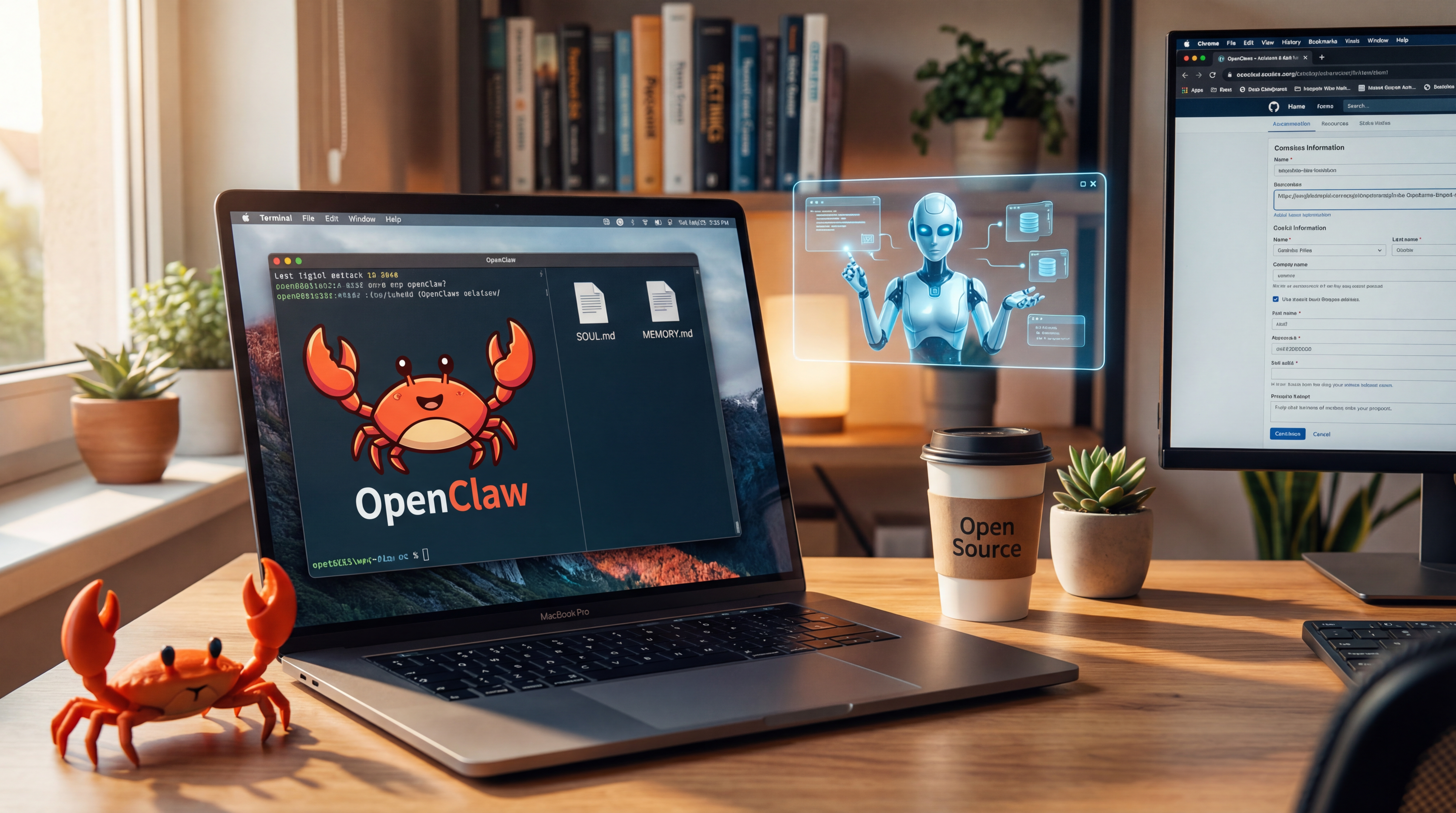
**Workspace = source of truth**: The agent's workspace directory contains everything: identity files (`SOUL.md`, `USER.md`), memory (`memory/YYYY-MM-DD.md` daily logs, `MEMORY.md` long-term), project context, and tool configurations. This makes agents **auditable, version-controllable, and forkable**.
**Heartbeats > polling**: Rather than constantly running background tasks, OpenClaw implements a heartbeat system where the agent periodically checks in, reviews priorities from `HEARTBEAT.md`, and decides whether to act or stay quiet. This dramatically reduces API costs while enabling proactive behavior.
**Subagents for delegation**: Complex tasks spawn isolated subagent sessions with their own context and token budgets. Your main agent stays focused on conversation while subagents handle research, content generation, or multi-step workflows.
The technical sophistication here isn't in novel ML research—it's in *systems design*. OpenClaw solves the orchestration, context management, and tool integration problems that make AI agents practical for daily use.
Why This Matters in the AI Landscape
**The agent framework space is bifurcating**:
On one side: Enterprise solutions (Microsoft Copilot, Salesforce Agentforce) optimizing for corporate workflows, compliance, and scale. Powerful, expensive, locked down.
On the other: Open-source autonomous agents (AutoGPT, BabyAGI lineage) optimizing for maximum independence, often burning tokens on circular reasoning and hallucinated plans.
**OpenClaw occupies a third position**: personal utility, human-in-the-loop by design, optimized for *effectiveness per token* rather than autonomy theater.
This matters because:
1. **Privacy and control**: Your agent runs on *your* infrastructure with *your* API keys. No vendor has access to your workspace, memory, or interactions. In 2026, as AI assistants become repositories of personal context, data sovereignty isn't paranoia—it's table stakes.
2. **Composability**: Every capability is a tool the agent can combine freely. Browser + calendar + messaging = "find dinner options near my 6pm meeting location and text recommendations to my partner." This emergent complexity from simple primitives is where value compounds.
3. **Human values as configuration**: Instead of RLHF's statistical approximation of human preferences, OpenClaw agents read `SOUL.md` and `USER.md`—literal text files defining personality, values, and user context. Want your agent to be more cautious? Edit a file. Want it to learn from mistakes? It writes to its own memory. This transparency is technically unsophisticated and profoundly important.
4. **Economic viability**: By combining smart context management (load only relevant memory), efficient tool use, and model flexibility (use cheap models for routine tasks), OpenClaw makes persistent agents financially sustainable for individuals, not just enterprises.
Critical Analysis: Gaps and Growing Pains
OpenClaw isn't a panacea. Several limitations deserve scrutiny:
**Security model is trust-based**: The agent has broad filesystem access, can run shell commands, and control your browser. The safety rails are "instructions in the prompt" and tool policies. For users comfortable with this (developers, power users), it's fine. For mainstream adoption, this is a blocker. The framework needs capability-based permissions and sandbox isolation before it's safe for non-technical users.
**Setup friction**: Currently requires Node.js runtime, API key management, and configuration. The project needs one-click installers and better onboarding before it competes with web-based chatbots on accessibility.
**No multi-agent coordination**: OpenClaw handles single-agent workflows beautifully. But coordinating multiple specialized agents (research agent, coding agent, communication agent) requires custom orchestration. This is a future frontier.
**Model context limits remain**: Even with smart memory management, Claude's 200K context window fills quickly on complex projects. OpenClaw doesn't solve the fundamental "what information to keep/discard" problem—it just makes it manageable.
**Limited mobile UX**: While OpenClaw has a mobile app for paired devices (notifications, camera access, screen recording), the primary interface is desktop-first. Mobile-native agent interaction is underdeveloped.
The Bigger Picture: Infrastructure for Thought Partners
OpenClaw represents a bet on a specific vision of AI's near-term role: not replacement, not pure autonomy, but **augmentation through deeply integrated assistance**.
The most interesting applications aren't flashy demos—they're mundane:
- An agent that knows your project structure well enough to refactor code across multiple files
- Morning briefings that combine calendar, email, weather, and news without prompt engineering
- Browser automation that handles repetitive form-filling while you focus on decisions
- Proactive file organization based on learned patterns
These are "10x quality of life" improvements, not "10x productivity" moonshots. The impact accumulates through daily compounding, not viral demos.
The open-source nature is crucial here. As users customize agents to their workflows, a Cambrian explosion of configurations, skills, and use cases emerges. The best ideas propagate through shared SOUL.md files and skill definitions. This ecosystem effect—not the core technology—may be OpenClaw's most significant contribution.
Conclusion: A Framework for Human-Scale AI
OpenClaw won't compete with ChatGPT for casual users or replace Salesforce Agentforce in enterprises. It's not trying to.
Instead, it's building infrastructure for a different future: one where AI agents are *personal* software, configured and controlled by their users, running on user-owned infrastructure, optimized for individual needs rather than platform lock-in.
In a landscape dominated by cloud-based, black-box AI services, OpenClaw's radical transparency—code, context, memory, all readable and modifiable—feels almost anachronistic. Like personal computing in the 1980s or open-source software in the 1990s, it's a bet that users will choose control and customization over convenience and polish.
Time will tell if that bet pays off. But for those building the future of human-AI collaboration, OpenClaw offers something increasingly rare: a foundation that respects user agency as much as it enables AI capability.
**Tags:** #OpenClaw #AIAgents #OpenSource #AIInfrastructure #PersonalAI #AgentFrameworks
**Category:** AI Technology
**SEO Meta Description:** OpenClaw is an open-source AI agent framework enabling persistent, personal AI assistants with deep system integration, human-in-the-loop design, and radical transparency. A critical analysis.
**SEO Keywords:** OpenClaw, AI agent framework, open source AI, personal AI assistant, AI agent technology, human-AI collaboration, autonomous agents, AI infrastructure
**Reading Time:** 8 minutes
**Word Count:** 987